News
Twenty years of partnership: Lloyd Mbasela reflects on the path towards safer journeys in Zambia

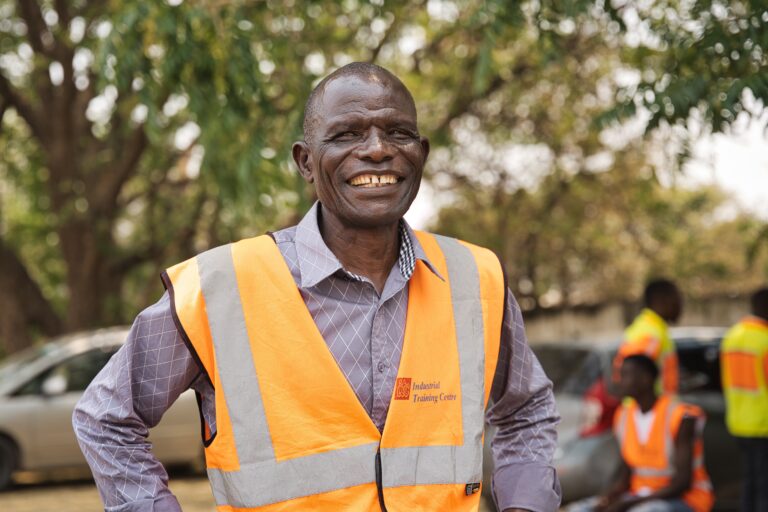
As Transaid celebrates 20 years of partnership with Zambia’s Industrial Training Centre (ITC), we speak to Executive Director Lloyd Mbasela about two decades of collaboration, the importance of professional driver training and his hopes for the future of road safety in Zambia.
For 25 years, Lloyd Mbasela has been part of the Industrial Training Centre (ITC) in Zambia, working across several roles before becoming its Executive Director. As he approaches retirement, he reflects on the institution’s development, the partnerships that have helped strengthen its training capacity and the opportunities that lie ahead.
Among these is ITC’s longstanding partnership with Transaid, which marks its 20th anniversary in 2026.
Established in 1986 through cooperation between the governments of Zambia and Germany, ITC was created to address a growing need for technical and vocational skills in Zambia’s transport and industrial sectors. Today, the institution continues to provide professional development for people already working in industry, alongside training opportunities for young people seeking practical skills and employment.
Professional driver training is a particularly important part of ITC’s work, helping to equip drivers with the knowledge and skills to operate vehicles safely, responsibly and professionally.
For Lloyd, this goes far beyond learning how to drive.
The importance of professional driver training
“Professional driver training is very, very important in any economy,” Lloyd explains.
He believes that professional driving must be recognised as a skilled occupation, requiring proper training and a strong understanding of road safety.
“An untrained driver is a very serious hazard on the roads. A qualified and trained driver understands exactly what it is to drive and to take care of other road users.”
Lloyd is particularly passionate about the wider consequences of road traffic crashes. Beyond the immediate risk of injury or loss of life, he highlights the financial and emotional impact on families, communities and the national economy.
“If safe driving is neglected, it brings a lot of challenges in society, in the communities we are living in. If somebody is involved in the road accident, what are the repercussions? The repercussions are so much so that sometimes we even tend to ignore what really happens.”
When someone is seriously injured, families may face significant healthcare costs and the loss of income. Where a life is lost, the consequences can be devastating, particularly for households dependent on that person’s earnings.
For Lloyd, investing in professional driver training is therefore not only about improving standards within the transport industry; it is also about protecting lives, supporting livelihoods and contributing to Zambia’s economic development.
A partnership built on a shared vision
Transaid and ITC began working together in 2006, united by a common ambition to improve road safety and strengthen professional driver training in Zambia.
Lloyd recalls how the two organisations recognised their shared priorities from the outset: “We have the same vision: we are focused on reducing road crashes and improving people’s livelihoods through professional driver training.”
Over the past two decades, the partnership has focused on strengthening ITC’s ability to deliver high-quality, sustainable training, combining investment in equipment with the professional development of its instructors.
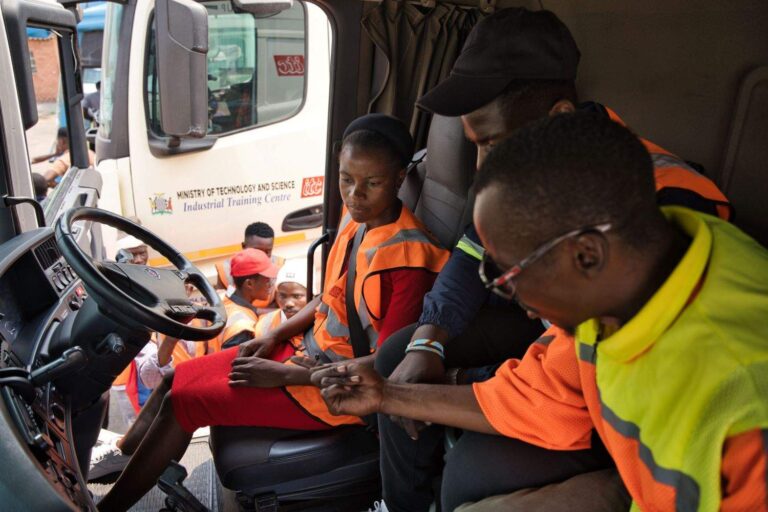
Through Transaid, ITC has benefited from access to training vehicles, teaching resources and opportunities for instructors to develop their skills and exchange knowledge with international counterparts.
The partnership has created valuable opportunities for knowledge sharing and mutual learning, bringing together transport professionals from Zambia and the UK to exchange knowledge, experiences and approaches to professional driver training.
This exchange of knowledge has extended beyond Zambia, with ITC instructors travelling to Sierra Leone to deliver motorcycle rider training, demonstrating how the institution’s growing knowledge is helping to strengthen road safety and professional training standards across the wider region.
Responding to growing demand
In recent years, ITC has experienced increasing demand for professional driver training, particularly as Zambia places greater emphasis on vocational education and equipping young people with skills that can lead to employment.
For Lloyd, this growing interest is encouraging, but it has also placed considerable pressure on the institution’s resources. As more students sought places on ITC’s courses, the number of available vehicles and instructors became a challenge.
“Looking at the number of learners that are coming, the equipment we have, including the number of trainers, we couldn’t meet the demand.”
When ITC raised these challenges with Transaid, the partnership helped mobilise additional resources such as training vehicles and laptops to support the institution’s expanding training activities.
Lloyd recalls the arrival of four additional trucks, which helped increase the number of vehicles available for practical driver training. “You can see the commitment,” he says.
Looking ahead: the future of road safety
Despite the challenges facing Zambia’s roads, Lloyd remains optimistic about the future.
“The future of road safety in Zambia, to me, looks brighter. Why am I saying so? We are having challenges and we are responding to these challenges.”
One area he believes requires greater attention is the rapid growth in motorcycle use.
Lloyd is concerned about the risks associated with riders operating without adequate training, appropriate protective equipment or the necessary licences.
He believes that professional training, effective regulation and collaboration between government agencies, training institutions and other stakeholders will be essential to addressing these challenges.
“As a government and as ITC, together with our supporting partners, we need to quickly move and intervene.”
ITC is already responding to changing transport needs through motorcycle rider training, alongside its professional HGV driver and forklift operator training programmes. Lloyd believes that a coordinated approach, bringing together training, licensing, enforcement and public awareness, can help create safer roads for everyone.
Building on 20 years of progress
From strengthening instructor skills and expanding access to training equipment to responding to growing demand for professional drivers, the partnership has continued to evolve alongside ITC’s priorities.
For Transaid, the anniversary is also a celebration of the dedication of ITC’s leadership, instructors and staff, whose knowledge and commitment underpin the institution’s work.
Lloyd’s appreciation for the partnership is clear: “We are very grateful and we value the partnership that we have with Transaid because it has yielded and it has continued yielding very positive results.”
After two decades of working together, the shared ambition remains the same: to strengthen professional driver training, support livelihoods and help make roads safer for everyone, in Zambia and beyond.
Recent Posts





Programme Partners




Corporate Partners