News

Maritha Longeveld: Championing safer, more inclusive minibus taxis in Cape Town
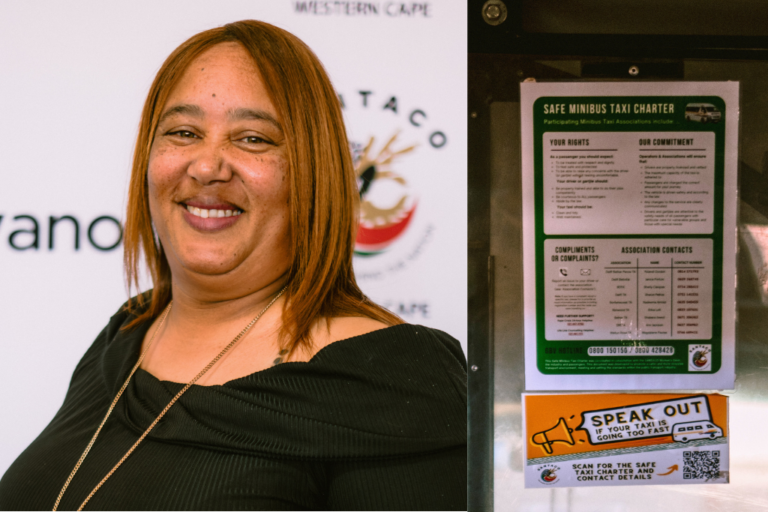
Maritha Longeveld is a 45 year-old minibus taxi business owner in Mitchell’s Plain, Cape Town, and a member of the South African National Taxi Council (SANTACO) Women’s Desk. While she has officially owned and driven a taxi for the past seven years, her connection to the industry stretches back much further — to when she met her partner at the age of seventeen.
“I haven’t been on the rank continuously, but when times were tough financially, then I stepped in and drove a taxi,” Maritha explains. “My church would always recommend me for outings and functions when they needed a driver. That became my speciality.”
For Maritha, the work is about more than transport; it’s about people. “I love serving people and I want to do it correctly, openly, and honestly,” she says. Maritha believes honesty and a strong work ethic are essential in the minibus taxi industry, especially as operators and drivers are often the public face of the sector.
Challenges facing women in South Africa’s minibus taxi industry
However, the industry has faced significant challenges in recent years. In Cape Town and across South Africa, the minibus taxi sector has been affected by violence, with 1,653 deaths recorded between 2017 and 2022 in Western Cape, Gauteng, and KwaZulu-Natal.
Women working in the industry also continue to face deeply ingrained gender stereotypes. Maritha recalls one incident during her pregnancy when a fellow operator told her: “Women should be at home. They shouldn’t be driving. You should cook food.” He went on to say that when women work, they “want to speak more than the man and be higher than the man.”
Addressing gender-based violence through safer public transport
These harmful attitudes contribute to the high levels of sexual and gender-based violence (S+GBV) experienced by women across South Africa. According to UN Women, South Africa’s femicide rate is approximately five times higher than the global average, while more than one in three women (35.8%) have experienced physical and/or sexual violence in their lifetime.
The minibus taxi industry reflects these wider societal challenges. Many women do not feel safe either working in or travelling by minibus taxi, creating barriers to accessing reliable public transport. This, in turn, can restrict their access to employment, education, healthcare and other essential economic and social opportunities.
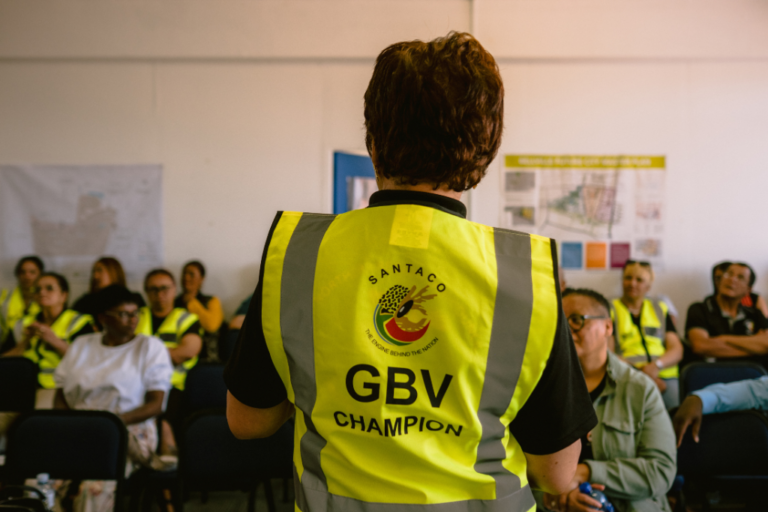
To help address this, Transaid worked with partners to develop a Safe Minibus Taxi Charter, with the aim of improving accountability among transport providers. This was complemented by sensitisation training for 124 drivers, sliding door operators and rank coordinators, designed to influence attitudes and behaviours across a predominantly male workforce, promote respect for women, and foster a safer, more inclusive public transport environment.
Nine minibus taxi associations representing nearly 500 vehicles across Cape Town have adopted the use of the Safe Minibus Taxi Charter, with strong support from women passengers; 95 percent of more than 1,100 surveyed backed the initiative.
“I’m very, very supportive of it. It will open many doors and break down barriers in our communities. Businesses could even benefit if customers see that drivers and sliding door operators understand gender-based violence and know how to support people.”
Championing women leaders
Maritha is also passionate about increasing women’s leadership within the sector, believing it could play an important role in tackling gender-based violence and changing harmful attitudes within the industry. “Women need opportunities to lead — not just to sit at the back, wash dishes at functions, or dish out food. They should also sit at the table and make decisions,” she says.
For Maritha, having more women in leadership positions could help create safer environments for both workers and passengers by ensuring that issues such as harassment, abuse, and discrimination are taken seriously and openly addressed. Greater representation, she believes, would also encourage more empathy, accountability, and support within the industry. “I would support women by voting them into leadership positions, and by putting myself forward for those roles too.”
There are moments, she says, when she feels especially proud of how far she has come.
“I can sit in an association meeting and my voice gets heard. Sometimes the decisions that are made are based on suggestions that came from me.”
Serving communities through transport
Despite the challenges, Maritha believes the industry still offers important opportunities, particularly for people who may have faced barriers to education or employment. “Education can sometimes be out of reach. Some people entered the taxi business at a young age and had to fend for themselves financially. Now the industry offers courses like first aid and gender-based violence sensitisation.”
At its core, Maritha says, the industry is rooted in community service. “The nature of the business is serving the community. We serve people with open hearts, while also creating employment opportunities for others. It’s our bread and butter.”
*Supported by the Canada Fund for Local Initiatives, Transaid worked with SANTACO and Sonke Gender Justice to develop the Safe Minibus Taxi Charter and conduct S+GBV sensitivity training.
View Maritha’s story as a PDF.

Recent Posts




Programme Partners





Corporate Partners