News

Meet Minivah and her son Trust: a journey to safe delivery
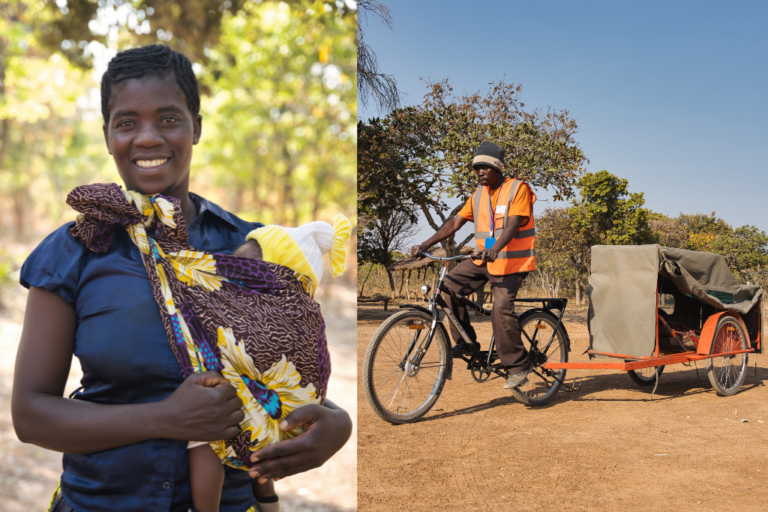
When Minivah Miselo began experiencing labour pains one afternoon, she knew she needed to reach the health facility quickly. Living in a rural community in Central Province, Zambia, distance and a lack of transport have long made childbirth dangerous for many women.
“I started feeling labour pains, so I called my mother,” Minivah recalls. “Then my mother called the rider to come and take me to the health facility.”
Within a short time, the community’s Emergency Transport System (ETS) rider, Vincent, arrived with the bicycle ambulance. Together with a Community Health Volunteer (CHV), who is also a member of the Safe Motherhood Action Group*, and Minivah’s mother, they made sure everything she had prepared for the birth was ready before helping her onto the bicycle ambulance.
“We left the community at around 2pm,” she says. “It was around 4pm when we reached the health facility at Kalela Rural Health Post.”
On arrival, the midwife examined Minivah and admitted her for observation. In the early hours of the following morning, at around 2am, she safely gave birth to a healthy baby boy.
Holding him proudly, she smiles. “This is Trust.”
The importance of health education and emergency transport
Looking back on her experience, she believes the service has transformed life not just for pregnant women in her community, but for everyone.
“Had it not been for the bicycle ambulance, a lot of people could have been dying in this community due to the distance.”
She describes the bicycle ambulance journey simply: “The journey was good, comfortable and faster.”
Today, when a woman goes into labour or experiences complications during pregnancy, families are able to call an ETS rider to help transport her to the nearest health facility.
“There were challenges before,” Minivah says. “But we always call the riders to come quickly and take us to the nearby health facility whenever we have issues. We are also being taught the danger signs of maternal emergencies through health education.”
The bicycle ambulance, part of an Emergency Transport System, supports Transaid and partners’ community-led approach to improving access to healthcare. Staffed by volunteer riders and custodians, they provide a vital link between rural communities and healthcare services.
For Minivah, choosing to give birth at a health facility was never in doubt.
“It is better to deliver at the health facility than delivering in the community,” she explains. “Here in the community, women can die, but at the health facility the health professionals are well trained and they save our lives.”
Transforming lives
Across sub-Saharan Africa, transport remains one of the biggest barriers to accessing healthcare. The region continues to bear a disproportionate share of the global maternal health burden, accounting for around 70% of maternal deaths worldwide in 2023. Long distances and the cost of transport often delay women from reaching skilled healthcare during pregnancy and childbirth.
Since Transaid’s Emergency Transport System programme began in Nigeria in 2009, more than 19,000 pregnant women experiencing labour or maternal emergencies have been transported safely to health facilities. In Zambia, the Mobilising Access to Maternal Health Services in Zambia (MAMaZ) programmes helped increase skilled birth attendance from 46% to 78%, ensuring thousands more women could give birth with trained health professionals by their side.
For Minivah, the impact of the bicycle ambulance is measured not in statistics, but in the safe arrival of her son, Trust. She hopes other families will continue to benefit from the same support from the community and the project.
With Trust in her arms, she has one final message:
“Thank you so much to everyone helping. We really thank you. We are being saved through the services that you have helped create with this community.”
*Launched as a national programme in 2008, Safe Motherhood Action Groups (SMAGs) are a key part of the Zambian government’s safe motherhood policy response. The Mobilising Access to Maternal Health Services in Zambia programme (MAMaZ) and its successor programme, MORE MAMaZ, supported the scaling up of the national SMAG initiative.
View Minivah’s story as a PDF.
Recent Posts


Programme Partners



Corporate Partners