Road Safety
Road Safety
According to the World Health Organisation’s (WHO) Global Road Safety Status Report (2023), global road traffic deaths have fallen by 5% since 2018 to 1.19 million.
However, the WHO African region is the only region in the world which has seen an increase in road traffic deaths. This makes African roads some of the deadliest in the world and is the leading cause of death for young people aged 5-29 years.
Transaid is committed to improving road safety, helping to achieve the ambitious target set out under the United Nations’ Sustainable Development Goal 3: to halve global road traffic deaths and injuries by 2030.
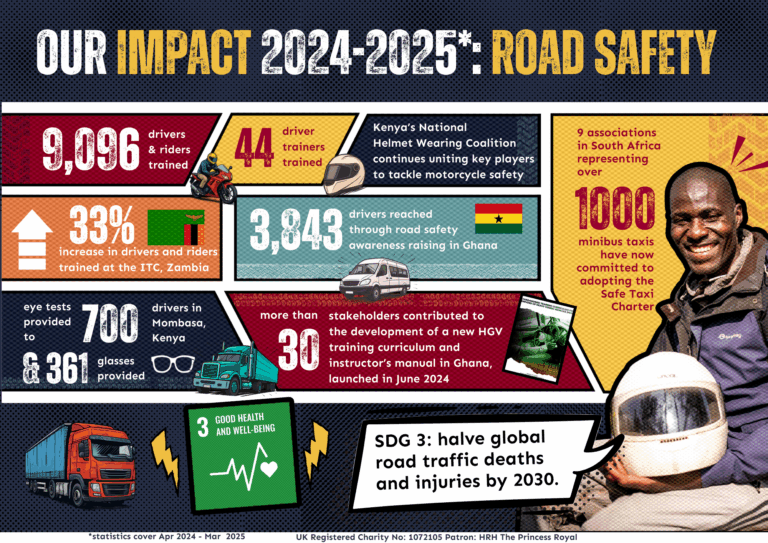
Click here for a full size infographic of Transaid’s road safety impact 2024-2025.
What We Do
We support drivers, governments, and training institutions to improve road safety.
We transform driver training. We promote safe driver behaviour and advocate for quality truck, bus and motorcycle training with long term programmes in Ghana, Kenya, Tanzania, Uganda and Zambia.
We encourage the exchange of skills and knowledge at national, regional, and global levels to deliver sustainable change to driver training standards across sub-Saharan Africa.
Our Impact
 Zambia
In 2008, we partnered with the Industrial Training Centre (ITC) in Zambia, which has proven to be an invaluable resource for improving driving standards and road safety.
From April 2024 to March 2025, 3,652 drivers and riders were trained at the ITC, a 33% increase on the previous year.
 Tanzania
In 2010, Transaid partnered with the National Institute of Transport (NIT) in Tanzania, where drivers have received HGV, PSV and CPC training. On numerous occasions training has been delivered by a professional volunteer working on behalf of Transaid. View a short video here on our impact in Tanzania.
From April 2024 to March 2025, the NIT in Tanzania trained 4,481 drivers and riders, including HGV, PSV and forklift truck drivers.
 Uganda
Phase Two of the Professional Driver Training – Uganda (PDTU-2) concluded with final reporting showing that Transaid and the Safe Way Right Way Driver Training Centre had exceeded the target of 750 trainees during the lifetime of the project, with 891 drivers trained (including 81 women).
Transaid continues to support SWRW, which remains a valuable partner for road safety and driver training in the region. The SWRW driver trainer centre trained 430 drivers between April 2024 and March 2025, an increase of 15% from the previous year’s figures with the majority being for new licence acquisition.
 Ghana
Ghana
In 2021, we launched a new road safety programme in Ghana, which follows our proven Train the Trainer model to build local skills to ensure sustainable and lasting change.
The Driving Safety across Ghana project launched in August 2024 and will run until January 2027. It builds on the success of 2021 Ghana project and aims to support the
nationwide rollout of the new HGV driver training standard.
More than 30 stakeholders contributed to the development of a new HGV training curriculum and instructor’s manual in Ghana, launched in June 2024.
 Kenya
Kenya
Phase 3 of the Kenyan National Helmet Wearing Coalition project, funded by the FIA Foundation, continues to unite key players to tackle motorcycle safety in Kenya and East Africa.
Also in Kenya, the Madereva Salama Zaidi project, funded by Lloyd’s Register Foundation, distributed road safety and health messaging to truck drivers in and around Mombasa port in partnership with North Star Alliance.
Held in Nairobi from 7–9 July 2025, the Safe African Helmets Initiative (SAHI) Summit convened policymakers, practitioners and industry experts from across Africa to accelerate progress on motorcycle helmet safety.
Building on the inaugural Kigali Summit, the event sustained momentum towards delivering the Marrakech Declaration, with new countries joining long-standing participants to develop practical, country-led action plans.
 South Africa
With support from the Canadian Fund for Local Initiatives, Transaid and partners worked to improve safer access to minibus taxis for women in low-income communities on the outskirts of Cape Town. In partnership with SANTACO Women’s Desk, Cape Crisis and Sonke Gender Justice, the project supported taxi associations to develop and adopt a Safe Minibus Taxi Charter, while building the capacity of industry Champions to prevent and respond to sexual and gender-based violence.
Through targeted sensitisation, training and the use of QR-coded in-vehicle materials linking passengers to information and reporting hotlines, the initiative strengthened accountability and safety for women using minibus taxis.